
SMA or EMA?
This template uses SMAs because they are the most common starting point. You can ask Torquant for EMA crosses instead — e.g. "Enter when EMA(12) crosses above EMA(26)" — and compare in a second run.
Strategy template
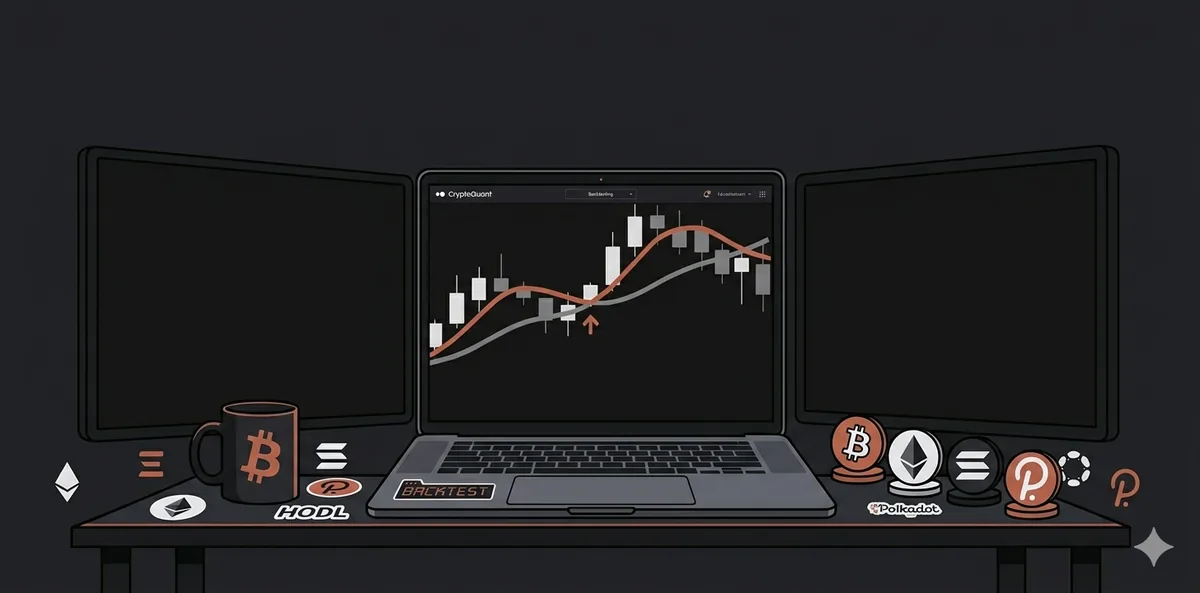
Moving-average crossovers are the bread-and-butter trend filter: go long when a fast average crosses above a slow one, exit when it crosses back. This template starts with the classic 8/20 cross on ETH 4h candles — the same shape of idea shown on the Torquant landing demo.
A simple moving average (SMA) smooths closing prices over N bars. When a fast SMA (e.g. 8 periods) crosses above a slow SMA (e.g. 20), the rule treats that as bullish momentum and opens a long. When the fast line crosses back below the slow line, the rule exits. No prediction — just a mechanical read of whether short-term price action is leading longer-term action.
Crossovers lag price. They tend to do well in sustained trends and give back profits in sideways chop. Backtesting tells you which regime dominated for ETH or BTC on the timeframe you pick.
Paste into Torquant and run. This matches the landing example: long when the 8-period SMA crosses above the 20-period SMA on 4-hour ETH candles.
Torquant prompt
"ETHUSDT 4h from 2021 to today. Long only. Enter when SMA(8) crosses above SMA(20). Exit when SMA(8) crosses below SMA(20). Use 50% of equity per trade."
Torquant prompt — BTC daily golden cross
"BTCUSDT daily from 2020 to today. Long only. Enter when SMA(50) crosses above SMA(200). Exit when SMA(50) crosses below SMA(200). Use 100% of equity."
Torquant prompt — ETH 4h with both directions
"ETHUSDT 4h from 2021 to today. Long when SMA(8) crosses above SMA(20). Short when SMA(8) crosses below SMA(20). Exit long on cross below. Exit short on cross above. 25% of equity per trade."
Torquant prompt — faster pair on 1h
"ETHUSDT 1h from 2022 to today. Long only. Enter when SMA(5) crosses above SMA(13). Exit when SMA(5) crosses below SMA(13). Use 30% of equity per trade."
Price history uses spot market candles. Leverage and short logic are supported in prompts; perpetual funding and liquidation are not modeled.
This template uses SMAs because they are the most common starting point. You can ask Torquant for EMA crosses instead — e.g. "Enter when EMA(12) crosses above EMA(26)" — and compare in a second run.
No magic — just typical trader habits. ETH 4h is a popular swing frame; BTC daily suits slower macro trend tests. Use whichever matches how you would actually trade the idea.
Yes. Add a filter like "and SMA(20) is higher than 5 bars ago" to avoid longs when the broader average is still falling.
Open Torquant, paste the default prompt, and see how an 8/20 crossover behaved on historical ETH candles.